
NEAR as an ecosystem identifies ownership––the ability for all people to control their own data, assets, and power of governance––as its most important shared goal.
In light of recent regulatory developments concerning the cryptocurrency mixing service Tornado Cash and the ensuing banning of several services, it’s important to reiterate the Foundation’s views on privacy, ownership, and regulation.
These are fundamental values for NEAR and for the Web3 movement more broadly. The ecosystem’s response to this watershed moment will have a lasting effect on the evolution of blockchain technologies and their regulation around the world.
Ownership and Privacy
The NEAR Foundation believes privacy is essential to autonomy and the protection of human dignity. It forms the bedrock on which many other human rights are built.
Privacy enables citizens to protect themselves from unwarranted interference and affords anyone the freedom to negotiate when and with whom they share information.
Everyone has a right to privacy because it is a critical aspect of ownership and autonomy. Individuals simply seeking to preserve their own privacy, or to build tools to support others in doing so, should not be criminalized. But each individual is also participating in a system that needs to be able to regulate itself. The NEAR Foundation believes in fair, reasonable, and proportionate regulation of blockchain technologies.
Web3 will never deliver on its potential if systems that allow participants to launder money, fund terrorism, or commit crimes are allowed to propagate. Blockchains are not starting entirely new systems from zero, in a vacuum. They are interwoven with existing systems of rule and law and must operate within and alongside them.
Work to be done
The Foundation acknowledges there is work to be done to educate regulators about the nuances of these tools. The goal is to build trust not erode it.
Some of this will be about compromise. Until privacy infrastructure is more mature, KYC at the edges of a system is required, but inside the system, participants should have the freedom to move around privately within it.
Improving and investing in zero-knowledge protocols is also critical: these allow the parties in a transaction to verify identities and validate sufficient data to establish trust while keeping specifics private. It’s something the NEAR Foundation and Pagoda are working actively on.
Combining the two will be especially powerful so that KYC doesn’t need complete access to one’s information at the entire expense of privacy. In this way, Web3 can create an improved paradigm that is better both at preserving privacy and preventing crime. And communities should be able to have enough information to govern their own exclusion lists and vote to ban people who don’t follow the rules of the system.
Collaboration and Community
While the Treasury’s decision to block and ban Tornado Cash is an overstep that may well create more problems than it solves, the Web3 community must recognize that more ill-informed decisions will be made if we don’t continue to make collaborative efforts to educate regulators.
A crypto-based Web will be much stronger only if it builds on the foundations of what came before rather than trying to rebuild an entirely new paradigm.
Total crypto-anarchy is not the answer. Pragmatic ownership is. We must continue to correct the balance between preventing crime and preserving individual privacy.
The Foundation believes in building communities that support the rights of individuals and enforce their own rules for working effectively together.
Next Steps
To continue the NEAR Foundation’s commitment to preserving privacy while respecting the rule of law, it will take the necessary steps to join Coin Center, the leading non-profit focused on the policy issues facing cryptocurrencies.
Second of all, the NEAR Foundation will actively seek to establish an association to help ensure that validators have better protections when it comes to censorship resistance, and will look to appoint board members to the NEAR Foundation Council that align with this mission.
Last, but not least, the NEAR Foundation is creating a grant fund for projects specializing in building Zero Knowledge (ZK) solutions to help preserve privacy while allowing projects and communities to comply with law enforcement.
If you’re a project working on ZK technologies, please make an application to the NEAR Foundations grant team here and mention ‘ZK Grant’ in the referral section. Feel free to reach out to [email protected] with any questions using the subject line ‘ZK Grant’.
The world is literally on fire. Europe, Asia and parts of America have all experienced record temperatures this summer, causing wildfires and devastation.
The world economy too, is running hotter than anytime in living memory. War wages in Europe, inflation continues to climb, energy supplies are dwindling, and food shortages are becoming the norm.
Last, but certainly not least, civil rights are in retreat. Women’s autonomy is under threat–half the world’s female population lack the ability to make choices about their own bodies–and democracy has been in decline in every continent for over a decade. The outlook for humanity is grim.
But amidst this backdrop represents a unique opportunity. An opportunity for Web3 to step forward and help re-imagine the world as we know it.
A broken system needs a new way of thinking
Crypto was born out of a crisis. When the Bitcoin whitepaper was released in 2008, the world was in the midst a recession the International Monetary Fund described as the most severe economic and financial meltdown since the Great Depression.
While the world has moved on, the issues that caused the depression still remain. The financial system that underpins this world has maintained its monopoly. The world’s global elite exert more control than ever. Governments have been ‘too slow’ in tackling the existential threat posed by climate change. And marginalised communities struggle to have their voices heard at a local and global level.
While there is no silver bullet to these issues, there are solutions, many of them being worked on in the Web3 space. But they are in their early stages, and need help. They need talent, money and voices from all walks of life to take part in shaping how this technology works.
Web3 was designed as an antithesis to what came before. At its heart is a vision to decentralise power and control, and help level the playing field when it comes to inclusion and participation. But those ideas are fragile, and need protecting. It’s one of the reasons I joined NEAR, and why I believe this project can contribute to this change.
One part of the puzzle
The technology that sits beneath NEAR is revolutionary. It has managed to find a working solution to the blockchain trilemma, creating a blockchain that is secure, scalable and decentralized. It’s also sustainable, achieving climate neutral status for two years in a row.
Built on top of that are more than 700 diverse projects from across the world. From education projects in Africa, to humanitarian aid projects in Europe and conservation projects in Latin America.
Alongside these projects, there is critical work being carried out to reimagine and repurpose what we mean when we talk about ownership, community and incentive.
Projects like Brave, Youminter, NEARPay and Tamago are rethinking what ownership means beyond the Web2 world of middlemen and rent seekers.
The NEAR Hubs program is bringing empowerment and inclusion to regions historically overlooked when new technologies are in their nascent stages.
Last, but not least, projects like Sweatcoin, and Open Forest Protocol are radically rethinking how to incentivise people to make changes in their lives for the benefit of everyone else’s.
But NEAR is just one piece of this puzzle. We believe that in order for change to happen, we need more voices, more ideas, more radical thinking to help take on threats to our very existence.
Now is the time to build. Now is the time for change.
If you want to learn more about NEAR, come and see us at NEARCON, or attend one of our regional events, or join our community.
The past several weeks have been challenging for many within crypto. This downturn is also very different from the previous 2018/2019 crypto winter as it is occurring against the backdrop of surging inflation, rising interest rates and global instability.
Crypto isn’t immune to these shocks, but the crypto ecosystem is more robust than it was three years ago. There is more capital than ever flowing into projects, an increasing amount of top talent, and a maturing of the infrastructure that provides a better foundation for more projects to flourish.
The NEAR Foundation has always focused on diligent and conservative treasury management, and as an ecosystem, we are therefore well-positioned to weather this storm. There has never been a better time to build on NEAR. A bear market is not a time to pause, it is a time to build, invest and organize to succeed – it is a time to put our best foot forward and execute at pace.
To better serve and address the needs of the growing NEAR ecosystem we have made a couple of structural changes to the NEAR Foundation organization, which are described below.
NEAR Foundation Mission
The mission of the Foundation is to foster the conditions by which an ecosystem can flourish, assisting and aiding others to reimagine business, creativity, and community in their own ways. The Foundation exists to help inspire and empower people to join the ecosystem, by acting as a trusted party and gateway into this new world. It is one part of a larger puzzle.
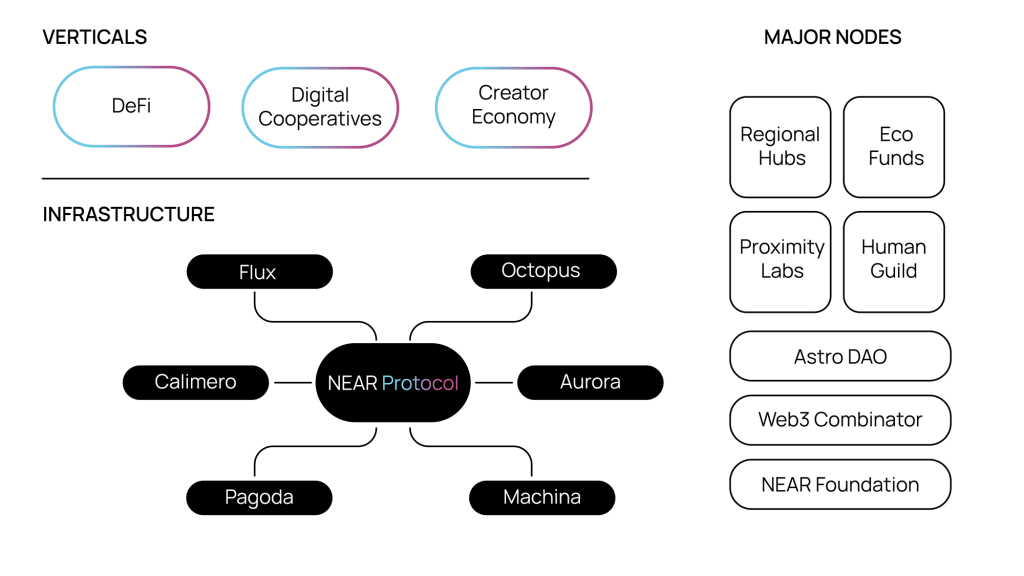
To help visualize how the Foundation interacts with the NEAR ecosystem we have developed a new mental model which is the basis for our internal OKRs, priority settings, and team priorities.
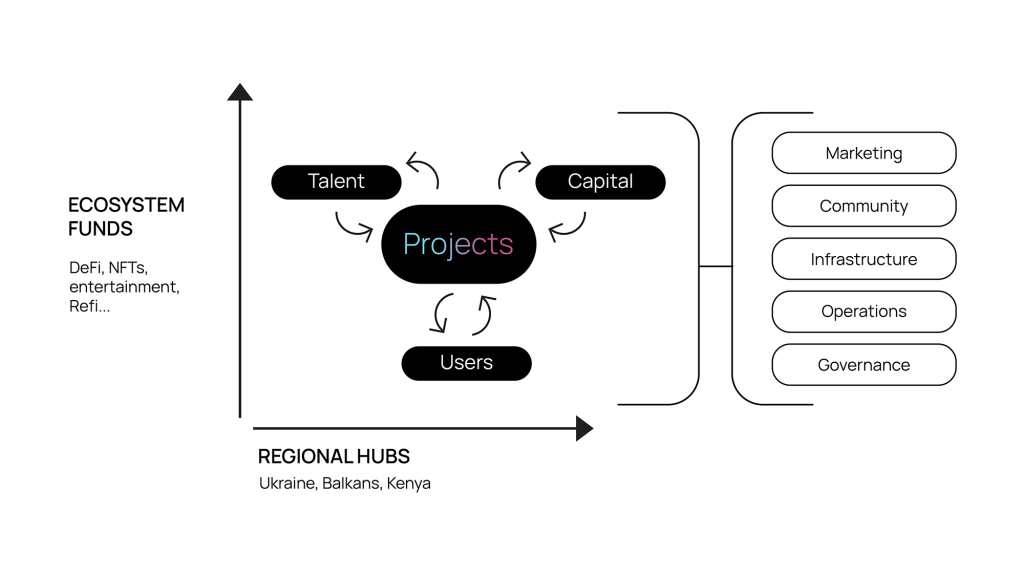
NEAR Foundation is a centralized organization championing decentralization as part of a decentralized ecosystem. Over time, NEAR Foundation’s role will continue to evolve as new funds emerge via ecosystem and regional funds, and as the community takes on more and more.
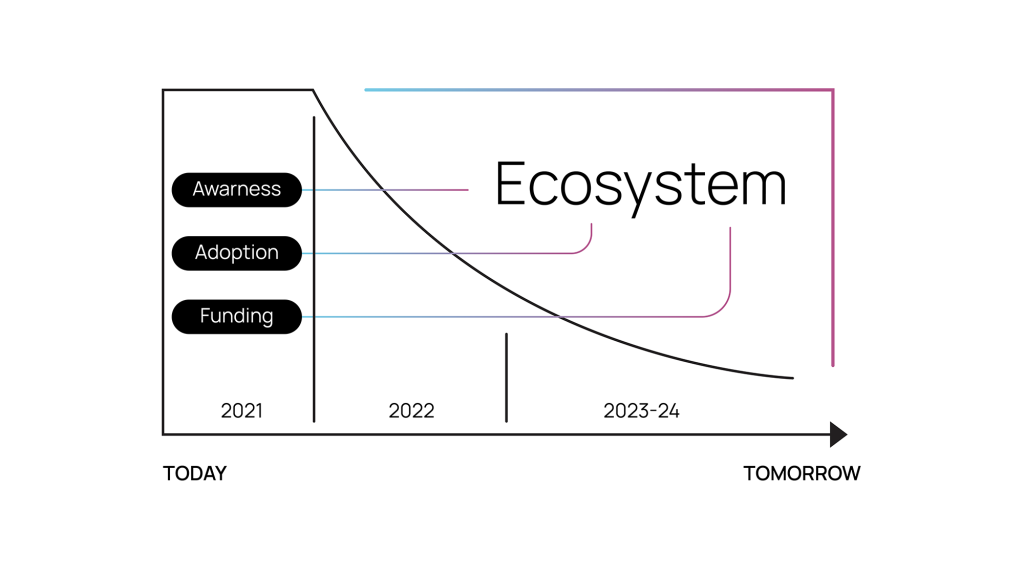
NEAR Foundation Changes
To best foster the conditions needed for the NEAR Ecosystem to continue its tremendous growth, we are reorganizing our teams alongside our key principles:
- Adopting a functionally aligned organizational structure across the Foundation, operating in a more streamlined way.
- Combining all our efforts on growing and supporting our community under one “Community Team”, to continuously focus and help address the needs of our growing ecosystem.
- Creating a product/engineering organization under new Product and Engineering leadership, which will enable us not only to re-purpose our website (the key entry point to the NEAR ecosystem) but also to have more perspective on products built in the ecosystem and be able to address technical queries for our partners more effectively.
To achieve this, we have created 16 new open positions for roles that help the Foundation achieve its mission. If you want to join us, or our ecosystem please check out – https://careers.near.org/jobs
As part of this reorganization, 17 team members will be leaving the NEAR Foundation. Most of these will move their skills into the NEAR ecosystem, joining one of the 600+ projects building the future of the web. Others will join NEAR hub and other community-led projects. Seeing friends and colleagues leave an organization is never easy. We are extremely grateful for their immense contribution, continued support, and participation in the NEAR ecosystem.
This is not a downsize, but a reorganization to better serve the needs of the ecosystem. We are very well positioned to succeed in the bear market. NEAR Foundation has always focused on diligent and conservative treasury management, and as an ecosystem we are therefore well-positioned to weather the storm. No better time to build on NEAR!
We are confident that being well organized is the first step in that direction and we are confident that our new structure is setting us up for success.
Marieke.
New music tools and platforms are popping up on blockchains, like NFTs, music software, Metaverse gatherings, and decentralized streaming platforms. With them, a new type of musician is coming into focus. One exploring novel creative technologies and more equitable revenue streams—on their own terms.
How exactly are musicians navigating Web3 in 2022? Let’s take a closer look at what’s happening on NEAR, where musicians are finding a fast, low cost, and secure blockchain, and an ecosystem of decentralized apps to power their Web3 journey.
New musicians on the blockchain
NEAR x Music (NxM), a guild for musicians and community-building, operates right at the center of blockchain music. Members are already witnessing musicians working in Web3 in several different ways.
Beyond minting NFTs, musicians are using Cryptovoxels, NEARhub, and other virtual or Metaverse spaces for live gatherings. In some cases, musicians use these spaces for music videos and other content.
“There is also more opportunity for musicians to sell their merchandise and music directly to their fan bases rather than depending on platforms as an intermediary,” the NxM Council says. “The blockchain allows you to see who is interacting with and collecting your work.”
Musicians in muti, a creative collective and DAO based in Portugal, are very active on NEAR. Apart from minting audiovisual NFTs, they promote each other’s music and stream original music and DJ sets through their Mutiverse on NEARHub.
“We are working in the digital and physical spaces,” says muti’s Tabea, noting that the collective often organizes events in nature and other non-urban areas. “As NEAR and its platforms develop tools, we’re experimenting with how to integrate the digital with the physical—ticketing, streams from nature into the Metaverse, utility NFTs, etc.”
But, not all musicians are trying to shift the industry paradigm. Some established artists simply want to explore new content distribution and revenue channels.
“Artists are taking advantage of opportunities in Web3 to ride the wave in parallel with whatever they’re already doing in Web2,” says Vandal, founder of DAORecords, a label founded on NEAR.
Origin is a musician and active community member of Amplify.Art, decentralized music platform currently building on NEAR. He points to Cryptopunk rapper Spottie WiFi, real name Miguel Mora, as an artist completely committed to blockchain music. Like David Bowie’s Ziggy Stardust or Damon Albarn’s cartoon band Gorillaz, Mora’s Spottie WiFi persona is an artistic avatar. A cryptovoxel purpose-built for Web3, Spottie WiFi partakes inNFT releases and Metaverse performances.
Other artists, like Emily Lazard, FiFi Rong, and even Deadmau5—who released the NFT single “this is fine” on NEAR—already have sizable followings. For them, Web3 helps grow their audiences and revenue.
“What’s most attractive about Web3 is the independence and control to do whatever you want,” says Origin. “What’s so interesting and exciting is the way you could combine any artform, be it poetry, sculpture, photography, video, graphic design, music, and spoken word into an NFT.”
Like other musicians exploring music NFTs, Origin is excited about the opportunity to earn more per release. With Web3, one neeedn’t make homogenous music just to get millions of streams.
Building and using music software
Musicians will also find new blockchain music software on Web3. And if they have the developer chops, they can design it.
Chiptune musician and developer Peter Salomensen developed WebAssembly Music, a live coding music and synthesizer in Javascript/AssemblyScript (WebAssembly) on NEAR. With WebAssembly Music, Salomensen has minted music NFTs and made them remixable. He also released a piano roll interface for short, editable music NFTs, on which musicians can create and publish their own music.
Endlesss, a Digital Audio Workstation (DAW), gives musicians the instruments and tools to produce music collectively. Founder and developer Tim Exile, a former Warp Records music producer, is on a mission to unbundle music from a product produced by professionals and consumed by the masses.
With the Endlesss app (iOS, MacOS, Windows), music becomes a collective journey. Musicians collaborate live or asynchronously in “Jams”. Think of them as “musical chat groups” in which participants create, share, and remix short bits of songs called “Rifffs”, short bits of songs. Artists share Rifffs that musicians or even fans can then remix and sample, which evolve over time like a musical exquisite corpse.
“That’s why we built Endlesss—to be collaborative and real-time so that it’s conversational,” says Exile. “Every step along anyone’s musical journey from creation, to curation, to discovery, to listening is one that brings you into contact with people.”
Call it the gamification of music collaboration and remix culture. As Exile notes, games aren’t prescriptive. Each level or an entire game can be completed in any number of ways, which is the goal of Endlesss..
“As you jam together, you build an entire history of everything that happened in that jam,” Exile explains. “So, it’s music creation as storytelling because as the jam evolves you listen to how the music evolves.”
“The first thing we’re building on NEAR is to share those Jams with an audience or other creators, and allow people to collect individual Rifffs as NFTs,” Exile adds.
In the future, Vandal expects tighter integration between music software and blockchain platforms. DAWs that could, for instance, export music files directly as minted NFTs.
“You could even mint the stems when you click ‘master’,” says Vandal. “I’ve seen a few products out there shifting over to Web3, and it’s going to be great as a creator when it’s all integrated into the hardware..”
One Endlesss community member even created a hardware controller for the music software. While it’s a proof-of-concept, it demonstrates how hardware could be integrated with blockchain software.
Reinventing remix culture and collaboration
The “Amen break,” a drum break found in countless 20th and 21st century recordings, is perhaps the most famous sample in music history. Best estimates suggest it has appeared on at least 5,500 songs. And yet the drummer who laid down the track, “G. C.” Coleman, a member of the 60s funk and soul band The Winstons, never got a penny from it. Coleman is a cautionary tale of sampled works: that while sampling can lead to great artistic works, the original creators deserve fair compensation.
The music industry clamped down on sampling after The Beastie Boys seminal album Paul’s Boutique (1989). Now, sample clearance can and often does stifle creativity by making it cost-prohibitive.
With blockchain technology, sample clearance and royalty payments could be made easier and cheaper for musicians. Artists and labels could simply make music available to musicians for sampling and remixing through smart contracts, cutting out middlemen, and allowing a new era of sample-based creativity to bloom. While a boon for new musicians, Vandal isn’t sure how this will impact older music that artists want to sample.
“It’s hard to say whether older music will be re-released to include on-chain splits to facilitate royalties,” Vandal says. “If it does, it could positively impact the future of sampling.”
To nurture remix culture, Endlesss will launch a marketplace with a smart contract that features a “remix royalty” for creators. The NEAR blockchain is unique in that a royalty function is baked in at the protocol level, unlike other chains where it can only be added after the fact.
“So, if someone buys a Rifff and starts a new Jam, then the participants in the Jam from which that Riff was purchased will collectively get a royalty,” he says. “Whether that royalty will be 60%, 20%, 80% is hard to say. I have no idea what people will feel is right.”
“The secret part of remix culture has always been recontextualizing,” says Exile. “It’s context to the power of 2: that’s actually where the value gets created. Splice is all-you-can-eat samples, and Spotify all-you-can-eat music, which is great for commodities but bad for culture because it commodifies it. Culture is all about meaning, purpose, and uniqueness, and I would say that all-you-can-eat and culture are incompatible.”
Exile also sees something else fascinating in blockchain-based sampling and remix culture. With smart contracts, musicians and listeners can trace sample attribution through layers upon layers of creation, like descending Wikipedia-style rabbit holes.
This just doesn’t happen with Web2 music software and streaming platforms. In Web3, musicians can be part of a new renaissance in music culture.
“There’s a golden opportunity to monetize culture through meaning rather than commodification,” says Exile. “This is how it should be, I think.”
Redefining the record label and royalties
Labels are facilitators—this won’t change in Web3. But, those labels that wish to operate in Web3 will have to rethink how they function.
“Record labels will most likely be DAOs, providing funding, support, resources, and even minting NFTs and performing other services to artists, as needed,” says Vandal. DAO labels can offer shared ownership, transparency, and a blockchain-inspired business model that appeals to artists.
Amber Stoneman, founder of Minting Music, a music-first NFT production and promotion company, says musicians under contract already have labels managing their NFT releases. Minting Music helps these labels, or artists that decide to forego labels, build NFT marketplaces.
In song publishing, there are multiple forms of ownership. Someone can own the overall master recording, while over 20 other individuals or entities can own rights to lyrics, composition, recording, and more. Song catalogs are bought out from under musicians and sold over and over again.
“In the Web2 space, musicians don’t know who owns their music or where it’s at,” says Stoneman. “We’ve never had technology like the blockchain to track things so clearly and transparently.”
“An artist can sell an NFT and it could make X amount of dollars, and they have just a few creator wallets connected to that smart contract, and the royalty splits are happening in real time,” she adds.
Artists will also be able to easily claim their copyrights in cases of dispute by using NFTs and on-chain data. Muti’s smokedfalmon says listeners and fans could also tip artists for their work.
Both muti’s Tabea and DAORecords’ Vandal believe simplifying royalty payouts with smart contracts will make artists more open and willing to collaborate and create work together. “Fractionalization of the publishing pie with fans or early investors is also an exciting possibility,” says Vandal.
“This is a plus from the community side of things, as Web3 can help in shifting the decision-making,” Tabea says. “It allows a collective, agency, or artist to use a DAO to not only hold and receive funds but integrate the wider community. So, fans and supporters can actually vote on decisions towards the future of the DAO/project, if the collective wants that.”
Creators and community are the future
With blockchain, the future of music is the creator. But no musical creator will exist in a silo or vacuum. Musicians can and will be more integrated with communities. New ones will pop up, morph, evolve, and die, becoming the seeds for new artistic communities.
“The creator proposition is in building, owning, and curating your identity in collaborating with others, on your own terms,” adds Endlesss’ Exile. “And the dynamics will propel people along those collective journeys.”
“Doing this work on NEAR over the last year with guilds and DAOs has given me confidence that I’ve chosen right,” says Vandal. “Community is everything,” Vandal says.
What needs to happen, in his opinion, is a true understanding of decentralization’s power. Sure, the new musician can leverage blockchain for their own benefit, but its capacity for community-building and engagement is potent. This, Vandal believes, can put the music industry on the path to revolution.
“It is definitely an exciting time for musicians,” he says. “We are history in the making.”
Check out the complete series on Blockchain Music:
Part 1: Music and Blockchain: Introducing the Future of Sound
Part 2: Building a Record Label on the Blockchain
Blockchain technology and Web3 are on their way to transform everything—particularly the world of art and music. Right now, the music industry is very much centralized, with Web2 streaming platforms (despite being extremely popular) often not getting the best deal for artists.
Blockchain solutions are working to solve this. Decentralized streaming platforms, like the NEAR-based Amplify.Art and Tamago, will give musicians more artistic control (and revenue). Music NFTs, already popular on NEAR, are also helping artists create a closer connection with fans.
Even the way live events sell tickets is finding its place in web3. Mintbase, an NFT minting platform built on NEAR, is experimenting with smart ticketing—selling tickets as NFTs to prove authenticity and prevent fraud.
One of the next logical steps is reenvisioning the record label. By decentralizing music, the hope is that a more fair and less byzantine system can take root, allowing musicians and other industry professionals flourish on more equal terms.
This future is already unfolding on the NEAR ecosystem, where musicians can learn to build on a super fast, low cost, and secure blockchain.
Reimagining record labels on NEAR
DAOrecords, a label built on NEAR, is a good example of the creative reimagining of a blockchain record label. Brainchild of hip hop musician, producer, and Web3 proponent, Vandal, DAOrecords is using blockchain to give artists their fair share through NFTs, automated royalty-splitting, and live events in metaverse venues.
DAOrecords will launch their alpha product in May through SoundSplash, a Metaverse event series. Until then, the label is helping artists navigate Music NFTs and Web3. And it’s not just DAO Records that is helping to create a hub for music NFTs on the NEAR ecosystem.
Last year, Ed Young (co-founder of The Source) and the Universal Hip Hop Museum (UHHM) partnered for NFT.hiphop, a collection of art/music NFTs featuring hip hop artists. The collection featured illustrations of the most famous hip hop artists, created by André LeRoy Davis. Mintbase also got into the tokenized music game with its release of Deadmau5 and Portugal. The Man’s collaborative NFT single “this is fine” in December 2021.
While NFT.hiphop and the Mintbase-Deadmau5 projects are creative experiments, DAOrecords is using NFTs to revolutionize the record label. Music NFTs are simply smart contracts that give fans ownership of songs, artwork, merchandise, and other unique assets. With original NFT collections, the idea is to create more personal connections between artists and fans.
Making royalty splits transparent
Vandal formed DAOrecords, in large part, to improve the distribution of music sales and royalties to artists. Like many music industry professionals, Vandal recognized the longstanding issue of artist royalties, which streaming platforms only amplified. After record labels, managers, and others take their cut of music sales and streams, musicians are left with meager income.. This model means smaller independent artists often struggle to hit billions of streams to earn a liveable wage.
“As an independent artist it can be really hard to compete in an industry that relies so heavily on streams,” Vandal says. He adds that we need to re-examine our relationship to streaming: artists are unable to know their audiences and have little connection with them. He says NFTs can be the new collectibles, replacing CDs or vinyl records, and bringing musicians and fans closer together.
Vandal adds that “blockchain can provide a layer of transparency and trust,” using music NFTs as an example. Everything is baked into smart contracts, and artists know exactly where funds will be allocated. Joining a music DAO can help artists participate in decentralized governance, request funds, and ultimately see every activity recorded on the blockchain.
DAOrecords is also heavily involved in the metaverse—the next, more interactive generation of the Internet. The label’s affiliated artists have been performing at metaverse events since April 2020, most recently at the Metaverse Music Festival in Decentraland last October.
Why build on NEAR’s blockchain?
NEAR’s super fast transactions and ease-of-use are obvious attractions to Web3 labels. But Vandal also says that creating a label on NEAR was perfect because of the variety of people using it.
“There is a sense of community and family with everyone doing different things,” he says. “It [has] always felt very much like a family.”
Beyond the ecosystems’ diversity and sense of community, Vandal chose NEAR after experimenting with Ethereum to mint music NFTs. The network worked well but he was put off by the high gas costs. NEAR’s fast and cheap platform was a better alternative. Vandal was also drawn to the tools available on NEAR, especially automated splits for contracts.
For song and album royalty splits, NEAR’s speed, efficiency, and cost is a natural draw for music industry folks. Jordan Gray, an electronic musician and co-founder of Astro DAO, says quick automated royalty payments are being transformed on NEAR.
In the music industry’s current royalty model, artists can wait months to get their cut from a Web2 streaming platform. NEAR’s platform can immediately split royalties for up to 40 people, as small as a fraction of a cent. This is something bigger blockchains, like Ethereum, can’t do because of cost.
“I don’t think anybody has taken advantage of it yet, or found the perfect formula,” says Gray. “But I think that is a key component to taking a part of the music industry and automating it—making them more efficient so artists can get more money for the music they create.”
Eventually, even listeners will receive rewards, it is hoped. By curating playlists of their favorite artists, Vandal says they will receive quick payments from artists depending on how well their selections do online.
Rethinking record contracts
For well over 100 years, music artists have signed contracts with record labels. This is set to change on Web3 platforms like NEAR.
Vandal says DAOrecords and others are moving away from the typical model of signing artists with paper contracts. Musicians will be in full control of their work with non-exclusive, non-IP (intellectual property) systems where they can release their own music, or even set up their own platforms, with the label.
These platforms will resemble a WordPress template on which artists will have their own “landing pages,” where fans can fully interact with them. Eventually, artists will create their own labels using web3 technology, he adds.
DAOrecords and others are also reimagining the way funds are handled. Vandal says money raised from NFT sales will be reinvested into the artists so they can do what they do best—create.
DAORecords’ approach to contracts is one path forward but there will be others. And if things get complex, artists can tap into the NEAR’s Legal Guild, which provides legal expertise and support to projects, DAOs, and entrepreneurs using the NEAR blockchain.
“Our main mission is to see how we can reimagine what a record label is,” Vandal says.
If all goes according to plan, and the future of music does find a secure place on the blockchain, then artists will be able to have a greater say in creative control, through music NFTs, and a better chance of receiving the money they truly deserve. Traditional streaming platforms will evolve into something more inclusive and fair, and live metaverse shows will be more viable.
After more than two years of a global pandemic, following what seemed to be a never-ending sequence of postponements, rescheduling, and cancellations, live music has returned in full force. From destination festivals to elaborate arena shows or even regional theaters and local clubs, venues are opening their doors to once again allow artists to perform and connect with their fans.
At the same time, musical artists’ revenues have also been shrinking in the centralized streaming music model dominated by big tech firms. On the most popular streaming services, a single track needs to be streamed more than 300 times to generate $1 in royalties for the artist. To further complicate payouts, rates are rarely paid at a flat rate per stream, agreements are ever-changing, different tiers and subscriptions impact pay rates, and streams are more valuable in various areas worldwide.
Just as musicians had to pivot during their absence from the stage and find new and meaningful ways to stay connected with their fans, the Web3 community has been incubating ideas in using blockchain to disrupt both the music industry’s physical release and streaming music models.
The future of music is being written today, on NEAR, by a vibrant and diverse community of artists, developers, fans, and more. Various music projects, led by teams of Web3 developers and entrepreneurs, are working to give power back to music artists while breaking down the walls between them and their fans.
This series will explore how artists, producers and musicians are taking control over their assets, and building music on NEAR.
An industry saturated with problems
Even with Web2 streaming music platforms, the recording industry’s model has remained essentially unchanged for nearly a century. Most record labels have one goal — maximizing profits. They hold on to as much of their earnings as possible and dictate unfavorable terms when establishing contracts with most artists, save for a handful of superstars able to negotiate more favorable agreements.
As traditional album sales have given way to streaming services, musicians often receive only fractions of a penny per play on popular streaming services. A vast and perplexing network of labels, publishers, distributors, royalty collectors, and other middlemen make getting paid as an artist an inefficient and exceedingly lengthy process with little transparency.
As a result, touring and merchandise sales have become necessary to earn as a musician in 2022. But as touring revenues fell over the last two years, musicians have more cause than ever to disrupt the traditional song and record publishing revenue.
Faster, more efficient creative control
Cutting-edge protocols for NFTs, fractional ownership, smart contracts, and real-time on-chain settlement of royalties make blockchain and the music industry a natural pairing. A blockchain boom in the music industry is imminent thanks to NEAR Protocol’s robust feature set already in use and hugely successful in areas like, non-fungible tokens (NFTs), and decentralized autonomous organizations (DAOs).
With each of these technologies, the architects of music’s future envision more manageable, faster, and more accurate payments for artists’ work. Through smart contracts, the existing, painfully slow process of royalty payments could be reduced from multiple months to mere seconds. Each time a listener presses play on a song, musicians could be paid near instantaneously, primarily due to NEAR’s Nightshade being theoretically capable of millions of transactions per second.
Smart contracts that settle royalty payments in real-time will obliterate the need for third-party middlemen, leaving more money in the hands of the artists and creators. Artists will be empowered to establish direct seller-consumer relationships with their fans, with blockchain technology as the foundation.
Beyond being extremely fast and super secure, NEAR’s blockchain is global in scale and exceptionally transparent. Fractional ownership already implemented on NEAR will bring a new level of transparency in proving ownership over a specific piece of music and confirming every individual with a claim to its copyright. Artists can have access to all streaming and fan activity data instead of the limited access to watered-down data that they currently receive from their label, distributor, or streaming platforms.
Writing the future of music on NEAR
The future of music is one where a radical change to the way music publishing, royalties, launching and managing record labels, and even building music software will be achieved. NEAR Protocol’s amazingly reliable and consistent blockchain is home to several exciting projects, each shaping the evolution of Web3 technology that can power the multi-billion-dollar recording industry.
Experimenting with audio NFTs, virtual events, and decentralized communities, the NEAR-based DAOrecords are building tools to enable musicians to “harness the power of the blockchain revolution.” Artists retain full ownership of everything they create and are not restricted by any contract. The label has now worked with over 100 artists, released over 350 NFTs, and produced over 50 virtual events for an ever-growing community.
“At its core, a label is just a facilitator,” says Vandal. “The new Web3 record labels will most likely be DAOs, providing funding, support, resources and even minting and other services an artist might require.”
“Their role will generally remain the same,” he adds. “But with shared ownership, transparency and a blockchain-inspired business model is what will make it appealing to artists.”
DAOrecords’ vision of the future is a music industry where artists have control over their music and the relationship with their fans and community, all within their economy powered by the NEAR blockchain.
Designed for the metaverse and the play-to-earn era, MODA DAO is a decentralized technology network and community spearheading the “Music3” movement, their term for the music industry’s Web3 adoption through NFTs, micro-licensing, DAO governance, and DeFi. With a suite of creator tools, underlying infrastructure, and a publishing ecosystem, they effectively remove middlemen, increasing value between creators and fans.
MODA is being established as a not-for-profit foundation to push Web3 music forward and establish a more sustainable future for audio creators. Powered by a DAO, holders of the MODA Tokens are invited into various ecosystem layers. They can back specific artists to increase their exposure and ranking or even stake into new songs before they are released, increasing visibility within the MODA catalog.
NFT.HipHop is a collaborative NFT art series featuring the work of illustrator André LeRoy Davis, established through a partnership between NEAR, the Universal Hip Hop Museum, and Ed Young, co-founder of The Source magazine. A celebration of the history of hip hop and its most iconic artists, the collection features NFTs of 47 legends – from Eazy-E to Lil Wayne – to honor the 47th year of the hip-hop era. A prime example of synergy between music merchandising and blockchain, the pop-up marketplace also highlighted some engineering innovations, including the advanced NFT developer and user experience on NEAR.
Driven by fans and a thriving community
NEAR’s roadmap includes an unwavering commitment to facilitating the decentralization of the network to the community. Just as power is placed into the hands of the developer and end-user community in blockchain, a shift of power from record executives and industry suits to the artists, creators, and fans will help realize the future of music.
NEAR x Music (NxM) is a community focused on music, events, NFTs, and music-forward tools. This vibrant, accessible, and inclusive community of artists, creators, developers, and fans fosters a unique environment where opportunities for collaboration are endless; and where knowledge, gleaned through community contributions, knows no limits.
“NxM is a hub for all artists, producers, and people who simply love music by generating values for all customers through different streams and activities,” says the NxM Council. “We expand the NxM community by connecting music lovers on Web3 space and nurture organic growth through activities such as funding musician’s projects, events, community campaigns, and media operations.”
Specifically, NxM helps musicians produce music projects and events with web3 tools like DAOs, NFT galleries, and marketplaces, as well as offline and online events.
“NFTs and the use of smart contracts is a way to split profits amongst collaborators,” the NxM Council says. “Music specifically tends to involve multiple participants to make a release come together. But by using smart contracts, especially with the tools built into Mintbase, artists are able to write splits into their contracts for both initial and secondary market sales.”
Poised to shift the paradigm of the music industry as a whole, NEAR’s unique architecture serves as the foundation and natural home for platforms and tools aimed at improving music fans’ experience and guaranteeing artists’ control over their valuable work. In a truly decentralized fashion, a strong, engaged, and growing global community is at the helm of this movement.
Paired with NEAR’s fast, secure, and scalable blockchain, this community of creators and consumers is becoming a formidable, rising force. Join NxM and the greater NEAR community as they prepare to usher in the future of music and write tomorrow’s verse.
Growth off the charts
From physical album releases to audio tracks in MP3 format available on digital storefronts, to entire catalogs being accessible within a streaming app, the recording industry has undergone several technological revolutions in even the last 20 years. Similar to how social music platforms have allowed artists to connect directly with fans and grow their influence, the advent of Web3 stands ready to once again change how artists and their fans create, manage, and interact with music.
Today’s record industry isn’t working for the vast majority of artists. NEAR Protocol’s rich and robust underlying infrastructure is the perfect platform for the growing Web3 music industry to call home. A fast, secure, and scalable blockchain has allowed projects to demonstrate that blockchain-based music rights administration is feasible and has the potential to benefit creators and consumers in significant ways.
As the global NEAR community places faith in indie artists, new companies, and industry figures, the momentum they’ve built will have no choice but to be recognized and adopted by the industry giants. Whether it’s the next symphony, chart-topping hit, or Indie B-side, the future of music is being written on NEAR, one note at a time.
The NEAR community’s extraordinary momentum continued into March, with a number of exciting launches, partnerships, hackathons, and more happening across the ecosystem.
While the events unfolding in Ukraine had a profound effect on many of the teams in the NEAR ecosystem, projects continued to deliver on their roadmaps as a testament to the community’s resiliency and borderless collaboration.
For a first hand account of what this experience was like, check out Maria Yarotska’s Medium post on her experience working on MetaBUILD II while fleeing the conflict.
Let’s have a look at what happened throughout the NEAR ecosystem in March.
NEAR and SailGP Partner on new DAO for sports teams
NEAR announced a multi-year partnership with SailGP, one of the world’s fastest growing sporting events, to explore the sale of a new team to a DAO (Decentralized Autonomous Organization) to be built on NEAR. The SailGP DAO will combine professional sports with community-focused engagement, bringing together sports fans and crypto users alike.
This new DAO team could join the SailGP starting line-up for Season 4 in 2023. SailGP and NEAR will partner on a number of exciting new projects to inspire Web3 developers building on the blockchain, as well as collaborate on NFT and gaming, events ticketing, mobile app integration, and more.
“We welcome NEAR to the SailGP family and we are looking forward to them participating in the most exciting racing on-water, featuring the world’s best sailors,” SailGP Founder Larry Ellison said.
Orange DAO selects NEAR as web3 startup partner
Shortly after partnering with Sail GP, NEAR Foundation announced another exciting project—this one with Orange DAO, a crypto collective created by Y Combinator alums that backs web3 startups.
Orange DAO selected NEAR as its preferred layer 1 blockchain for web3. In return, NEAR Foundation will invest $15 million into Orange DAO to help support the founders who are building web3 companies on the NEAR blockchain.
“We are thrilled to have been selected by some of the brightest minds in the world as the preferred layer1 chain on which Orange DAO members will want to build,” said Marieke Flament, CEO of the NEAR Foundation. “We know that community-driven innovation benefits everyone, and this partnership is simply another example of our mission in practice.”
Orange DAO will leverage NEAR’s strengths to back past, present, and aspiring Y Combinator founders. The DAO will do this by helping founders apply to and get accepted into YC; funding pre-and post-YC projects; as well as mentoring founders and helping with recruitment and customer acquisition where possible.
NEAR Foundation’s funding of Orange DAO will vest over four years, and the Foundation will also support YC founders with time and resources.
Unchain Fund launches DAO to collect donations for Ukraine
On February 25, Unchain Fund, a new DAO fund, launched on the NEAR ecosystem to help collect crypto donations for citizens caught up in the conflict in Ukraine.
Created on AstroDAO, a DAO-launching platform built on NEAR, Unchain Fund raises funds for humanitarian purposes in Ukraine, including evacuation, shelter, food, and more.
In under a month, Unchain collected over $7 million USD and counting across a range of cryptocurrencies including, BSC, ETH, Harmony, NEAR, and Polygon.
Over 700 volunteers are currently helping out with Unchain Fund in one way or another, and the effort continues to grow.
“Crypto became the largest driver for humanitarian help as well as some of [the] military help for Ukraine,” said Illia Polosukhin, co-founder of NEAR. “You can create a full system, an NGO system in days. Instead of [the] months it would take to create a new nonprofit, set up bank accounts, get all the legal structure, make sure that people can wire money to it without problems.”
MetaBUILD 2 hackathon winners
Over the last three months, NEAR developers and entrepreneurs from around the globe have been building projects for the MetaBUILD 2 hackathon. This virtual-physical event was a great opportunity to witness the NEAR Community’s creativity and innovation.
By building on NEAR’s simple, scalable, and secure blockchain, the MetaBUILD 2 hackathon projects are helping lay the foundation for a better future. A future in which millions of new users and developers create and share completely new journeys.
Like the first hackathon, MetaBUILD 2 offered a total of $1 million in prizes. Nearly 4,000 participants joined, submitting over 356 projects—of which, 186 were eligible—for NFTs, DeFI, Gaming, DAOs, infrastructure apps and tools, and EVM apps.
For the NEAR MetaBUILD 2 hackathon, there were Welcome and Natives tracks, as well as 35 Sponsor Challenges.
Check out the list of winning MetaBUILD 2 projects.
NearPay debit card bridges crypto and fiat
Earlier this month, NearPay, the NEAR ecosystem’s first debit card and payments widget, announced its waitlist. NearPay had hoped to attract 1,000 users but the wait list grew to 18,000 in less than a week.
Built by Switzerland-based Kikimora Labs, NearPay bridges fiat and crypto in a single seamless user experience. Slated for a late 2022 release, NearPay debit will be both a physical card and mobile-based app, with feature sets designed for consumers, developers, and merchants, allowing individuals, businesses, and other organizations to make instant transactions and payments using their preferred cryptocurrency, including NEAR.
“The cards will be NEAR-oriented but support other cryptocurrencies as well,” says Ivan Ilin, Chief Operating Officer at NearPay. “For businesses, we support two scenarios: fiat-to-crypto to a user’s wallet and fiat-to-crypto to a merchant’s wallet for a certain order. We work with NFT marketplaces, DeFi projects, and many others.”
“For developers, we provide a simple API with an SDK,” he adds. “The integration is possible with a website or a mobile application. We provide a merchant dashboard where one can see all the transaction statistics.”
A Deep Dive into DAOs
If 2021 was the year of the NFT, then 2022 is the year of the DAO. As Web3’s popularity continues to grow amongst end-users and developers, so has the interest in and launches of DAOs. And it’s easy to see why: these decentralized autonomous organizations empower communities instead of centralizing data, power, and money in the hands of big Silicon Valley firms.
To capture the explosive growth of DAOs on the NEAR ecosystem, the NEAR Foundation published a 5-part series on these unique Web3 creations, including a DAO primer, a spotlight on NEAR’s DAO launchpad Astro, life-changing DAOs, and more.
Capsule.Social’s Blogchain launches writer program for Ukrainian migrants
Capsule.Social’s Blogchain, a decentralized publishing platform for writers, launched this month and quickly followed this up with a new writer program designed for Ukrainian migrants. Through this program, a number of Ukrainian writers have been sharing their personal stories, experienced during Russia’s war on Ukraine.
Blogchain gives these Ukrainians and many other writers a user-friendly interface, created with powerful decentralized functionality, that also includes censorship-resistant content hosting, payment to creators in either crypto or fiat money, and community governance.
Follow the Capsule.Social Twitter for stories from Ukrainians and other writers publishing on the decentralized Blogchain platform.
ICYMI: NEAR’s Road to Decentralization
In early March, NEAR Foundation published a 4-part series “Road to Decentralization”, in which it explore the various ways in which the network is being decentralized to the community.
Since launch, NEAR Foundation has been committed to decentralizing the network as part of the larger effort to build a fast, secure, and scalable blockchain.
For the full details on this process, read “Road to Decentralization” parts:
- 1: Decentralization Road Map
- 2: A Deep Dive into Aurora
- 3: Empowering the Guild Community
- 4: Building Bridges
Hello, NEAR World. 2022 is shaping up to be the year of the DAO. Join the community for NEAR’s March Town Hall on March 21, 5:00pm GMT (1:00PM EDT/10:00am PDT) for a deep dive into NEAR’s ecosystem of DAOs.
NEAR Foundation CEO Marieke Flament will open the Town Hall with some updates on the ecosystem and the Foundation’s progress in advancing Web3.
There will also be a flurry of news and NEAR protocol updates, including ecosystem funding and education efforts, the MetaBUILD 2 winners, news on new events, and a panel focused entirely on DAOs.
There will also be talk of Ukraine, especially how DAOs have stepped up and supported humanitarian relief efforts.
MetaBUILD 2 Hackathon Winners
Since December, the NEAR community has been hosting the MetaBUILD 2 hackathon—the biggest one yet, with over 3,900 participants and 20+ partners.
Pagoda’s Maria Yarotska will be at the March Town Hall to talk MetaBUILD 2, including how the war in Ukraine impacted the judging process. Maria will also update the community on the winning teams and projects, and will share information on upcoming hackathons.
A Panel on DAOs
NEAR Foundation CEO Marieke Flament will return to talk briefly about the DAO community on NEAR. There will also be a panel focused on DAOs, with surprise guests from several different Web3 platforms and DAOs.
Register for the March Town Hall
To join the conversation with the global NEAR community, register for the March Town Hall.
The global community is being heard. Web3 continues to surge in popularity as developers and end-users alike instill confidence in decentralized blockchains, where information lives transparently and out in the open, in direct opposition to Big Tech’s private, opaque databases storing massive amounts of data.
Just as NFTs went viral in 2021, DAOs are now emerging as 2022’s hottest Web3 topic. Within the NEAR community, Decentralized Autonomous Organizations (DAOs) are exhibiting rapid growth while bringing more project diversity to the ecosystem.
Decision making from the bottom-up
A decentralized autonomous organization, or DAO, is a formalized, self-governing community, analogous to an internet-native Web2 company—where control is centralized. Owned and managed by its members, a DAO carries out a set of instructions determined by prewritten smart contracts, with voting required by members for any changes to be implemented. At its core, the DAO has a built-in treasury that no individual has the authority to access without the approval of the group, fostering the “trustless” environment championed by Web3 platforms.
The first-ever DAO, created in 2016, made waves when its token sale raised the equivalent of $120 million USD, making it one of the largest crowdfunding campaigns in history. While the DAO’s underlying principles and core values remain the same, they have experienced a remarkable evolution in the last several years.
Uniquely Web3 with unmatched power
In 2022, new Web3 users will find DAOs quick to set up, global in scale, extremely customizable, and exceptionally transparent. Think of them as a toolbox that invites anyone to create a business structure with elegant simplicity and flexibility baked in. As such, an immense diversity of structures and scenarios emerge from them. Flat or hierarchical, open to everyone or members-only, the power is invested in the stakeholders to determine how the community should be governed.
The power of DAOs is being harnessed right now by communities to advance a number of missions, made possible by NEAR’s extremely fast, super secure and infinitely scalable protocol. In grants giving, DAO members vote and collectively decide which people and projects to fund. Businesses can track owners’ equity and elect managers to make day-to-day decisions, while investors utilize DAOs to pool funds and vote on strategy and decisions. Clubs of any kind can use the DAO toolbox to elect leaders and decide where to spend group funds.
The DAOs on NEAR are diverse, creative, and boundless in terms of growth. Reinventing the social internet, decentralizing finance, providing structure for various Guilds, and working in areas like legal and software development, these are just a few examples of DAOs that leverage NEAR’s sharded blockchain infrastructure.
The types and number of DAO use cases grow daily, and its true potential is just beginning to be realized.
Together we can do so much
The lion’s share of DAO community growth on NEAR can be seen in blockchain infrastructure and the decentralized finance, or DeFi, space. By total assets, the largest DAOs are Aurora, a token exchange bridge between NEAR and Ethereum, and Octopus, a platform for launching and running Web3 independent, custom blockchains, known as “appchains”.
DAOs don’t stop at providing structure for organizations blazing entirely new trails. They are also serving as the foundation for organizations challenging our preconceptions of social networks and even music recording and distribution.
Feiyu, a picture-based social network on NEAR, allows users to express creativity through memes and GIF sharing. In its novel take on social media, it all happens in an NFT-based metaverse where users earn tokens or NFT items for participating in the community.
Elsewhere on NEAR, DAO Records is reimagining the record label, building tools that will help write the future of the music industry, while working to fairly compensate musicians for their songwriting and recording work. Its founders are encouraging artists to release and package new music as audio NFTs, whose smart contracts allow for an entirely more equitable royalty structure, in perpetuity.
On DAO-powered social platform t² (short for time²), launching in late 2022, users explore a world of narratives “curated by time.” Feature articles are created, curated, and propagated under a curation market mechanism where all participants are fairly rewarded for the network value they contributed. t² acts as the first organization in the Web3 space attempting to monetize human time with the consensus achieved by “Proof of Attention.”
Supercharging the NEAR community
DAO launchpads are gearing up the NEAR community through platforms that allow individuals to join forces with others and create guilds for meaningful projects and more.
Sputnik DAO, a hub for NEAR’s DAO ecosystem, has a platform that welcomes and rewards creators of all kinds within the NEAR community. Individuals can receive rewards by submitting proposals to existing DAOs, it’s that simple. Meanwhile, developers are able to quickly and efficiently build apps on Sputnik because it makes use of coding languages that are already widely known, such as Rust and AssemblyScript. Paired with NEAR’s support and community engagement through Near Academy and the NEAR Certified Developer program, Sputnik is approaching 250 DAOs with a total of nearly 20,000 transactions completed on-chain.
Helping propel NEAR’s ecosystem to become one of crypto’s most diverse, AstroDAO is empowering groups anywhere in the world to make decisions together, collectively. In less than 10 minutes, and without a line of code, everyday users are able to launch a DAO using AstroDAO’s powerful platform. With over 100 DAOs and counting, and a total locked value approaching 90,000 $NEAR, AstroDAO is now a catalyst helping to bring communities together that thrive in the NEAR ecosystem.
The key to AstroDAO’s early success has been a feature set that has been incredibly well-executed on their platform, powered by NEAR. Central tenants are democratic by default, ensuring that decisions like distributing funds and member admissions happen through an intuitive and transparent voting process. Thanks to smart contracts, funds are held in a treasury and always distributed through a community-defined process. Who votes and how it works can be precisely configured to meet a community’s preferred operating style.
Extremely versatile, DAOs act as one component of NEAR Protocol’s commitment to facilitate the decentralization of the network to a worldwide community on a fast, secure, and scalable blockchain. Through their democratic, flexible, and collaborative foundations, DAOs are empowering like-minded individuals to come together and take action in a truly global way.
Robust and disruptive in nature, prepare yourself as 2022 shapes up to be the year of the DAO, powered on NEAR.